


 Islamism
 1355
1355 


For years, the fight against terrorism was fought primarily on the battlefield. Success was measured by the number of militant leaders eliminated, weapons caches destroyed, or terrorist cells dismantled. That era now appears to be over. Today, the battlefield lies at the heart of international financial networks, where the funds that enable extremist organizations to survive, recruit, and reorganize are channeled. For Washington, money has become the true center of gravity of the threat.
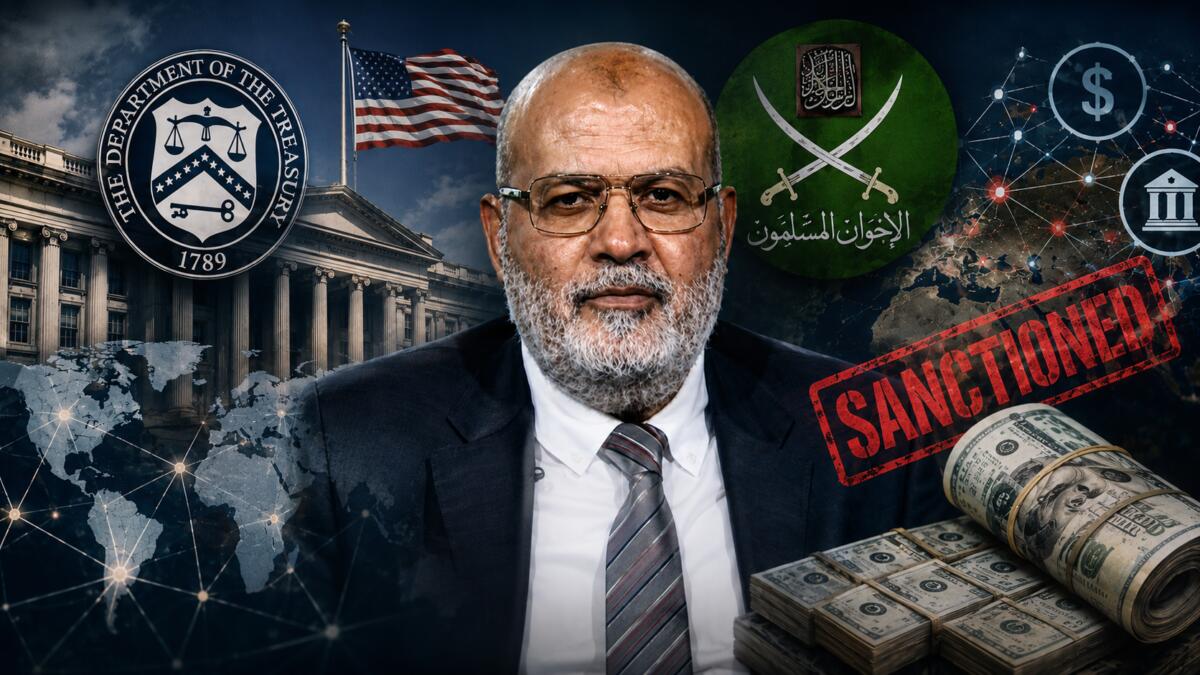
The latest round of sanctions announced, on July 23, 2026, by the U.S. Department of the Treasury through the Office of Foreign Assets Control (OFAC) illustrates this strategic shift. By targeting a senior Muslim Brotherhood official, several individuals linked to the movement, and a number of entities based in the United Kingdom, Turkey, Indonesia, and the Gaza Strip, the United States is no longer merely freezing assets. It is now seeking to dismantle an entire transnational financial infrastructure.
The decision to sanction Mahmoud al-Abyari, head of the Muslim Brotherhood’s General Secretariat based in the United Kingdom, goes far beyond targeting a mere operative within the Islamist movement. According to the Treasury Department, al-Abyari played a role in raising funds for organizations already sanctioned over their alleged ties to Hamas, including Palestine Waqfi and Hayat Yolu, while mobilizing Brotherhood networks to provide financial support to the Palestinian Islamist movement. With this decision, the U.S. Treasury has crossed a new threshold: it is no longer focusing solely on the operators of financial networks but is now reaching the leadership figures allegedly responsible for coordinating them.
This development reflects a profound shift in Washington’s understanding of terrorist financing. U.S. authorities no longer see it as a series of isolated financial transactions but rather as an interconnected ecosystem in which charitable organizations, commercial companies, activist networks, digital platforms, and informal financial channels operate as parts of a single structure.
The timeline of the sanctions confirms this long-term strategy. Following the measures adopted in January and March 2026, this third package is not an isolated action but another phase of a methodical campaign. Each investigation uncovers new intermediaries, while every round of sanctions reveals additional branches of the network, gradually reconstructing the financial map of Hamas.
This strategy relies on close cooperation between the Treasury Department, the FBI, the Drug Enforcement Administration (DEA), and U.S. border control agencies. Countering terrorist financing is no longer limited to financial intelligence. It now encompasses smuggling networks, money-laundering schemes, informal money transfer systems, cryptocurrencies, and, more broadly, every form of transnational criminal activity capable of sustaining extremist organizations.
Charitable organizations occupy a central place in this new offensive. Washington alleges that Towjah Bola Global, also known as Seven Spikes Global and based in Indonesia, was established to raise funds for Hamas. Meanwhile, Madad Palestine, operating in the Gaza Strip, is accused of using humanitarian aid as a front to divert part of the donations toward military activities.
This approach reflects a conviction now firmly established within U.S. agencies: charitable organizations represent one of the principal channels for clandestine financial networks because they enjoy considerable public legitimacy while often operating under less stringent oversight than the traditional banking system.
Another key component of this financial architecture is the network of informal money exchange companies. Cairo General Trading, based in Turkey, is accused of transferring hundreds of thousands of dollars to Hamas while providing informal financial services using both conventional currencies and cryptocurrencies. Its owner, Khaldoun Khamis Zakaria al-Din, along with several associates, has also been targeted over alleged links to various international financial crime networks.
This aspect illustrates the evolution of U.S. doctrine. The distinctions between money laundering, organized crime, and terrorist financing are increasingly blurred. From Washington’s perspective, these activities rely on the same financial channels, intermediaries, and vulnerabilities created by globalization.
The Treasury Department describes this system as a “multi-layered financing model.” According to U.S. authorities, funds are collected by charitable organizations in several countries before passing through informal money exchange companies operating outside the conventional banking system and ultimately being redistributed to local entities, particularly in the Gaza Strip. This geographic fragmentation makes financial flows especially difficult to trace, as each jurisdiction adds another layer of opacity.
Beyond their immediate financial impact, these sanctions carry a broader political message. First, they reinforce Washington’s assertion of a financial link between the Muslim Brotherhood and Hamas. Second, they warn that no foreign bank, financial intermediary, or company can facilitate transactions involving sanctioned individuals or entities without risking exclusion from the U.S. financial system.
Finally, this latest offensive highlights the expanding geographical scope of America’s financial war. Once focused primarily on the Middle East, it now extends to Europe, Turkey, and Southeast Asia, reflecting Washington’s view that Hamas’s financial infrastructure operates on a truly global scale, with key nodes spread across several continents.
U.S. Treasury Secretary Scott Bessent summarized the strategy in a single statement: “Whether they operate under the cover of charities, businesses, or clandestine banking networks, anyone who supports Hamas will be identified, sanctioned, and held accountable.”
The objective is therefore no longer simply to weaken an armed organization on the battlefield but to gradually dismantle its entire financial ecosystem. In this silent war, bank accounts, shell companies, digital platforms, and informal money-transfer networks have become strategic targets in their own right. For Washington, victory in the fight against terrorism will depend as much on controlling global financial flows as on conducting security or military operations.