


 Islamism
 2249
2249 


Despite an attempt by the Ministry of the Interior to ban it, political Islam made a major comeback at the Bourget Exhibition Center. For this annual Muslim Brotherhood fair, the first in seven years, calls to mobilize the Muslim electorate, victimhood narratives, denunciations of secularism, and the promotion of the veil and Islamic clothing, including for young girls, drew a large audience.
Since 1984, the Le Bourget Exhibition Center in Seine-Saint-Denis has hosted Europe’s largest annual gathering linked to the Muslim Brotherhood: the Annual Meeting of Muslims of France (RAMF), organized by the Union of Islamic Organizations of France (UOIF), which became Musulmans de France (MF) in 2017, the French branch of the Muslim Brotherhood.
For over thirty-five years, this flagship event of networks connected to the Muslim Brotherhood in France embodied an openly political form of Islamism: a mix of religious fervor, halal commerce, ideological debates, and calls for community mobilization.
Each spring, up to 170,000 people (a record reached in 2013) flooded the vast halls to attend conferences, collective prayers, educational workshops, and a large trade fair selling jilbabs, books by preachers, and Islamic products. Central figures of European Islamism, such as Tariq Ramadan, were regular attendees, attracting young people searching for identity.
The UOIF—considered the historic French branch of the Muslim Brotherhood—promoted a structured vision of Islam: civic engagement alongside the assertion of a distinct Muslim identity, with recurring themes such as calls to vote, a victimhood stance, and criticism of secularism perceived as oppressive.
Until its last edition in 2019, the event took place without major interruption, despite numerous controversies. It was presented both as a spiritual fair and a political platform: denunciations of Islamophobia, appeals to Muslim voting, and the building of European networks with participants from across the continent.
On April 3rd, 4th, and 5th, the return of the Bourget gathering marked a dramatic comeback. On-site, as attendees queued to enter, the air vibrated with renewed fervor. Despite a slow start on the first day, the event drew 40,000 participants according to organizers.
An event that nearly never happened. Until the last minute, uncertainty loomed. On April 1st, the Paris police prefecture, acting on orders from Interior Minister Laurent Nuñez, banned the gathering, citing a “significant terrorist risk targeting the Muslim community,” threats of counter-demonstrations, and a tense international context.
Just hours before opening, the Paris administrative court suspended the ban, ruling that the risks were not sufficiently substantiated. A dramatic twist that gave the event unexpected publicity—a true “Streisand effect.”
The following day, Saturday April 4th, queues grew longer. Inside, the atmosphere was both festive and militant: stands selling Islamic clothing (including jilbabs for young girls), religious books—some openly anti-homosexual—, a memorial dedicated to victims of the “genocide” in Gaza, and donation drives. NGOs followed one another to raise funds, while conferences such as “The Freedom Flotilla” or “15 Days in the Hell of Gaza” attracted younger visitors.
The event also benefited from the support of numerous social media content creators, each encouraging followers via Instagram stories to attend and meet them at the congress.
Mobilizing for the 2027 Presidential Election
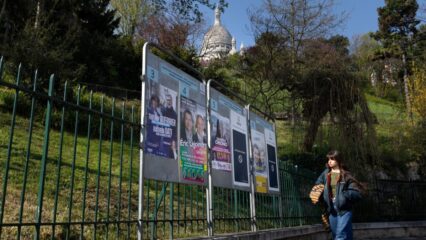
The stakes of this return were clearly stated during panel discussions: the need to mobilize a communitarian electorate in upcoming elections.
The room filled up for a debate titled “Separatism Law: Is the Rule of Law in Danger?” Equipped with connected headphones—designed to prevent unauthorized recordings—participants listened to Bernard Godard (former advisor to the Interior Ministry on Islam), lawyer Sefen Guez Guez (former CCIF counsel), and Éric Dufour (head of the Averroès Muslim high school in Lille).
All painted a bleak picture of Emmanuel Macron’s 2020 speech in Les Mureaux: dissolutions of associations, “traumatizing” searches, and a new bill in preparation.
“There is a political agenda,” insisted Bernard Godard, notably accommodating toward his Islamist interlocutors. Dufour, whose school regained its state contract in 2025, added: “We may have to wait until 2027 for the veil to no longer be an issue. We are in a democracy—let’s use the ballot box!”
In the afternoon, sociologist Raphaël Liogier made a striking return. Fired up, he addressed the crowd: “I think Muslims are too timid! We must take to the streets massively!”
Calling for a “convergence of struggles” and a unified response, he was supported by Feïza Ben Mohamed, a former CCIF figure now a journalist for Anadolu Agency (close to the Turkish government). She regretted the lack of mobilization and the “absence of clergy in Islam,” comparing Muslim representation unfavorably to that of the CRIF and “certain rabbis.”
François Burgat, a long-time ally of the Muslim Brotherhood and regular at the Bourget gathering, joked: “You are all Muslim Brothers, and I am an Islamo-leftist!”
Asked about accusations of “entryism” following a 2025 government report, he pivoted to praise La France Insoumise: “I like LFI—they are saving honor.” Applauding the election of an LFI mayor in Saint-Denis, Burgat encouraged attendees to “get involved locally.”
The Shadow of Tariq Ramadan
This year, the absence of major headline speakers was particularly noticeable. The name most frequently mentioned in conversations was, unsurprisingly, Tariq Ramadan—the grandson of Muslim Brotherhood founder Hassan al-Banna.
The absence of the Swiss preacher, a central figure in past editions, unsettled attendees. Just weeks earlier, on March 25, 2026, he had been sentenced by the Paris criminal court to 18 years in prison for rape and aggravated rape against three women.
On-site, references to him—as well as to Hassen Iquioussen—remained cautious but recurrent. Feïza Ben Mohamed lamented, without naming him explicitly, the lack of prominent Muslim figures “silenced” for being too effective in mainstream media.
One attendee even claimed on the microphone that it was “a completely empty case with complainants who imagined stories,” without being challenged. Lawyer Sefen Guez Guez remained more cautious:
“There is a justice system; he has the possibility to appeal—we’ll see what comes of it.”
A European and Generational Strategy
The event continued with conferences on AI, spirituality, and family workshops.
Makhlouf Mamèche, president of Musulmans de France, and Abdallah Ben Mansour (former UOIF leader and president of the Council of European Muslims in Brussels) outlined the future of the congress in notably explicit terms.
Ben Mansour officially announced the event’s renewal in 2027, with a new ambition: a European scope through the Brotherhood’s networks within the Council of European Muslims, which he leads.
Behind calls to vote and activist stands, organizers are clearly targeting youth and long-term influence. The “Streisand effect” turned the threat of a ban into a popular success.
In a context of ongoing tensions surrounding separatism, the Palestinian cause, and legal cases that have marked the community, the Bourget Congress signals not only a return but a deliberate repositioning: that of an Islamist movement determined to mobilize—at the ballot box, in the streets, and on the European stage.
The message is clear: after six years of enforced silence, the Muslim Brotherhood is back—and intends to play a significant role in French political life.