
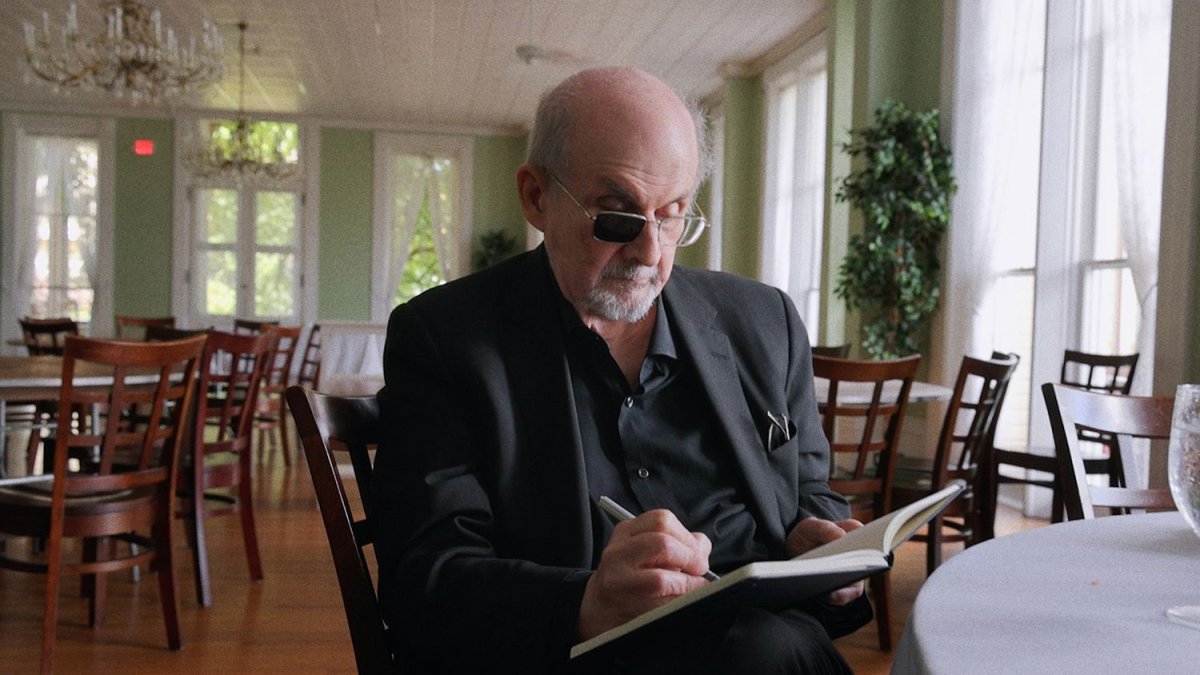



 Salman Rushdie

 23769


There are coincidences that even a novelist would hesitate to invent, for fear of being accused of laying it on too thick. On the evening of August 11, 2022, Salman Rushdie is happy. He has just finished reviewing the proofs of “Victory City”, his new novel. From his hotel window, he photographs the Moon and sends the picture to his wife, the poet and photographer Rachel Eliza Griffiths. A few hours later, on the stage of the Chautauqua Institution in New York State, a young man bursts out of the audience and charges towards him, knife in hand. When he regains consciousness in hospital, the first image that comes to mind is a scene from an old film made in 1902: a rocket blinding the Moon!
Rushdie survived. But his body bears the bloody map of the attack: deep wounds, severed nerves, a badly injured hand and, above all, the permanent loss of his right eye. Thirty-three years after Ayatollah Khomeini issued a fatwa against him on February 14, 1989, following the publication of “The Satanic Verses”, the past had violently caught up with the writer.
It is precisely in this space, between 1989 and 2022, that Alex Gibney situates his documentary “Knife: The Attempted Murder of Salman Rushdie”. For the real question is not who held the knife at Chautauqua. It is whose hand armed it. This is where Gibney’s film derives its full force. It places the assault within the long procession of violence unleashed around “The Satanic Verses”: demonstrations, book burnings, death threats, effigies of Rushdie hanged or set alight by furious crowds, from London to Karachi…
Lying in his hospital bed, the writer’s mutilated body resembles the final frame of a film that began in 1989. For three decades, the threat had inhabited television screens, speeches and demonstrations. In August 2022, it stepped out of the screen and went for the writer’s throat. It now had a face, an arm and a knife.
Yet the documentary’s most harrowing images do not come from the archives unearthed by Gibney. They were filmed with a small camera bought on Amazon by a terrified woman.
When Rachel Eliza Griffiths learns of the attack, she does not know whether her husband will survive. Then, when doctors begin to consider the possibility of his recovery, Rushdie suggests that she document his convalescence. He imagines a few images taken on a phone. She chooses a camera.
What follows is one of the strangest filming experiences documentary cinema could conceive. A woman films the man she loves: his swollen face, battered flesh, bloodstained bandages and destroyed eye. There is no comfortable “documentary distance”. The man in front of the lens is not a subject. He is her husband. And when she switches off the camera, Griffiths does not leave the set: she simply puts the device down and becomes once more the wife keeping vigil at his bedside.
Perhaps it is this blurring of love, pain and cinema that gives the images their extraordinary power. The camera no longer offers protection from reality. On the contrary, it becomes a way of looking horror directly in the face.
And then comes a flash of irony so characteristic of Salman Rushdie: as he regains his senses, he remembers an image more than a century old. A scene from Georges Méliès’s “A Trip to the Moon”, a silent film made in 1902: a rocket plunges into the eye of the celestial body, which grimaces in pain.
The day before the attack, Rushdie had tenderly photographed the Moon for the woman he loves. The following day, he awoke with a destroyed eye. For the author of “Midnight’s Children”, it is hard not to smile at this macabre twist of fate.
But behind the irony lies an infinitely more serious question. Since 1989, the Rushdie affair has been less about the fate of a writer than about the fate of an idea: the notion that a text can be answered with a death sentence, words with a blade. The Chautauqua knife did not merely destroy an eye. It attempted to sever the fragile thread separating two worlds: one in which a book is answered with another book, and another in which, when words fail, someone reaches for a knife.
Salman Rushdie survived. And he continues to write. Perhaps that is, ultimately, the cruellest answer he could give to all those who would silence him…