


 Cinema
 1041
1041 


When the Cannes Film Festival unveils its selection, it never merely lines up titles. It maps the present, redefines the balance between world cinemas, and, in subtle ways, sketches a certain idea of the times. The announcement of the 79th edition (May 12–23, 2026), made in Paris, was no exception to this rule: it reads less like a program than like a statement.
At first glance, the equation seems simple: 21 films in the official competition, with the promise of an additional title that could bear the signature of Steven Spielberg. But behind this arithmetic lies a more subtle composition: that of a fragile balance between heritage and renewal, between established figures and emerging voices.
General Delegate Thierry Frémaux put forward an impressive figure—2,541 films submitted. An undeniable vitality, despite the economic and political tremors affecting the film industry. Yet the essential point lies elsewhere. It resides in the way this vast body of work is transformed into a selection that seeks less to reflect the world than to interpret it.
The return of major names feels inevitable, but it is an inevitability charged with meaning. Pedro Almodóvar returns with Bitter Christmas, continuing his exploration of intimate fractures, now tinged with a darker gravity. Asghar Farhadi, with Parallel Stories, shifts his moral theater to France, where ethical dilemmas take on a new dimension. As for Hirokazu Kore-eda, he surprises with A Sheep in the Box, a venture into humanist science fiction where the family becomes a hybrid construct, both physical and technological.
More than these anticipated returns, however, it is the very geography of the selection that intrigues. A strong European and Asian presence contrasts with an American cinema reduced to a minimal share. It is as if Cannes, once again, is asserting its role as a bastion of global auteur cinema, resisting the industrial logic of dominant studios.
Within this framework, some filmmakers return to confront their own legacy. László Nemes revisits the memory of World War II with Moulin, dedicated to the great figure of the French Resistance, Jean Moulin. Paweł Pawlikowski plunges back into a wounded Poland with The Homeland, while Cristian Mungiu continues his moral dissection in Fjord, set in Denmark, outside his usual Romanian territory.
Among the most anticipated projects, The Coward by Lukas Dhont alone embodies the creative uncertainty that runs through this edition. A war film on the surface, a meditation on the notion of courage in reality, it was received and screened by the selection committee only on the eve of the official announcement—a subtle reminder that even Cannes is not immune to doubt and unpredictability.
Politics, meanwhile, surfaces without ever imposing itself directly. In Minotaur, Andrey Zvyagintsev transforms intimacy into an allegory of contemporary Russia. Elsewhere, collective memory—wars, national fractures, painful legacies—feeds several narratives, as if attempting to recompose a shared meaning.
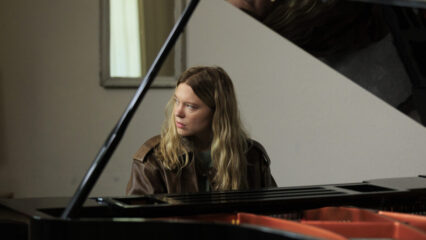
The presence of women, still limited to five directors, nevertheless suggests a gradual evolution. From Valeska Grisebach to Marie Kreutzer, alongside new voices in French cinema (Jeanne Herry, Léa Mysius…), Cannes seems to be moving, cautiously, toward a rebalancing.
Finally, what runs through the entire selection is a blurring of forms. Science fiction, historical drama, musical storytelling, or fragmented narratives: boundaries dissolve. Cinema here no longer seeks to categorize reality, but to embrace its complexity.
It would therefore be wrong to reduce this selection to a simple race for the Palme d’Or. It is first and foremost a reflection of an unstable world, which filmmakers are less trying to represent than to reformulate. Between films completed at the last minute, still-secret works, and promises yet to unfold, Cannes remains true to what defines its singularity: a place of tension, uncertainty, and invention.
And perhaps that is precisely where its necessity lies.