


 Cinema
 27425
27425 
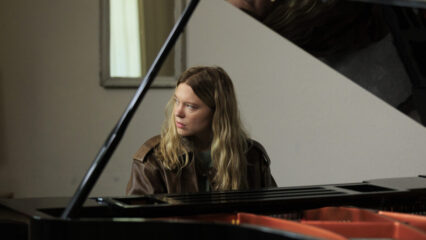



“Muganga – The One Who Heals” retraces the fight of future Nobel Peace Prize winner, Dr. Mukwege. In the heart of Central Africa, Denis Mukwege advocates and treats, at the risk of his life, thousands of women who are victims of sexual violence and mutilations. His meeting with Guy-Bernard Cadière, a renowned Belgian surgeon, would breathe new life into his commitment. Together, they would operate, four hands at once, so that these women could regain dignity and hope.
Produced by Petites Poupées Production, written and directed by Marie-Hélène Roux, starring Isaach de Bankolé, Vincent Macaigne, Manon Bresch, Déborah Lukumuena, and Babetida Sadjo, “Muganga – The One Who Heals” is a biographical drama of formidable effectiveness. The director knows Congo intimately. Every shot of every face attests to this. It took her ten years to bring this project to fruition. The work is vital at a time when masculinist ideologies and expressions of virility are rising, including from international political figures such as Donald Trump, Javier Milei, or Vladimir Putin.
With this film, the imagery of the strongman is cast aside. Marie-Hélène Roux offers a complex perspective on wars that use women’s bodies as the ultimate weapon. A silent weapon that has existed for millennia, but that crushes without making noise. “Muganga – The One Who Heals” breaks the silence and forces awareness.
The images spare us nothing. Rapes unfold before our eyes. These soldiers of horror draw sticks, knives, rifles, and even bottles to destroy their victims’ vaginas. To this unspeakable carnage, Dr. Mukwege responds: “This violence is not your reality!” He insists that these wounded women not define themselves as victims. He knows that the 1,100 women raped every day in Congo are forced to apologize to their villages or marry their rapists. He knows that fighting soldiers also means fighting mentalities, to have outrage and crime recognized. Little girls, adult women, or elderly women are accused by those around them of having lost their virginity, of having provoked it. They then lose their families, their studies, their futures. All that remains for them is Dr. Mukwege’s hospital, which has become a lifesaving refuge: “I repair them, but they repair me too.”
If soldiers mutilate the female genital apparatus, they avoid killing their prey. “A dead woman does not speak.” Alive, they testify, and warn that it is better to be afraid than to rebel. In the minds of the executioners, terror must be instilled to force populations to abandon rich and coveted lands.
This vile strategy nevertheless allows these painful words to reach us—media, international populations, associations, states… Once alerted, the international community can no longer be complicit through silence or absolve itself with the handing out of medals: “Prizes and decorations, what do they change?” the main character asks. For while his action and this war medicine have been rewarded, the atrocities continue.
To watch “Muganga – The One Who Heals” is to encounter the woman who loses her mind because rapists forced her two sons to rape their mother; the one who, pregnant, refuses the unborn child; the one who believes she is guilty; the one who, reconstructed, risks being raped again… But above all, it is to turn attention to other parts of the globe, far from the more publicized conflicts. The post-#MeToo era is in dire need of intelligent works like this one, on the painful subject of rape.
“Muganga – The One Who Heals”
– By Marie-Hélène Roux (France, 1h45).
– Screenplay: Marie-Hélène Roux, Jean-René Lemoine
– Staring: Isaach de Bankolé, Vincent Macaigne, Manon Bresch, Déborah Lukumuena, Babetida Sadjo
– Release date: September 24, 2025
Box
Rape in cinema
In 1985, Steven Spielberg directed “The Color Purple” with Danny Glover, Whoopi Goldberg, and Oprah Winfrey, adapted from Alice Walker’s epistolary novel of the same name, winner of the Pulitzer Prize in 1983. The story of a young girl, in 1900, abused by her father. The director of E.T. was able to film the condition of Black women, give them a voice, a truth on a highly difficult subject, too rarely treated in cinema in the 1980s.
In 1988, “The Accused” by Jonathan Kaplan was released, inspired by the tragedy experienced by Cheryl Araujo, an American woman raped by four men in 1983 in a bar in New Bedford, Massachusetts. This courtroom drama denounced the flaws of the American judicial system, pointing the finger not only at the rapist but, above all, at those who witnessed the assault without intervening. A work that left a lasting mark, contributing to a shift in mentalities and raising awareness about the atrocity of this crime and the clichés suggesting that a woman entices or provokes her rapist. That is what makes the victim a suspect. Jodie Foster won the Oscar for Best Actress in 1989 for her performance in this film.
Just like in these two pioneering films, the women filmed by Marie-Hélène Roux are strong yet vulnerable, crushed by a system entrenched in harmful reflexes. Because “raped” is not an identity, some resist and are not broken: “I am still a woman thanks to Papa,” the affectionate nickname Congolese women have given to the man who rebuilds, after the destruction of the body, of the mind, of a country. Dr. Mukwege still practices in Congo. He persists, despite all the threats and risks, in answering hate with love.